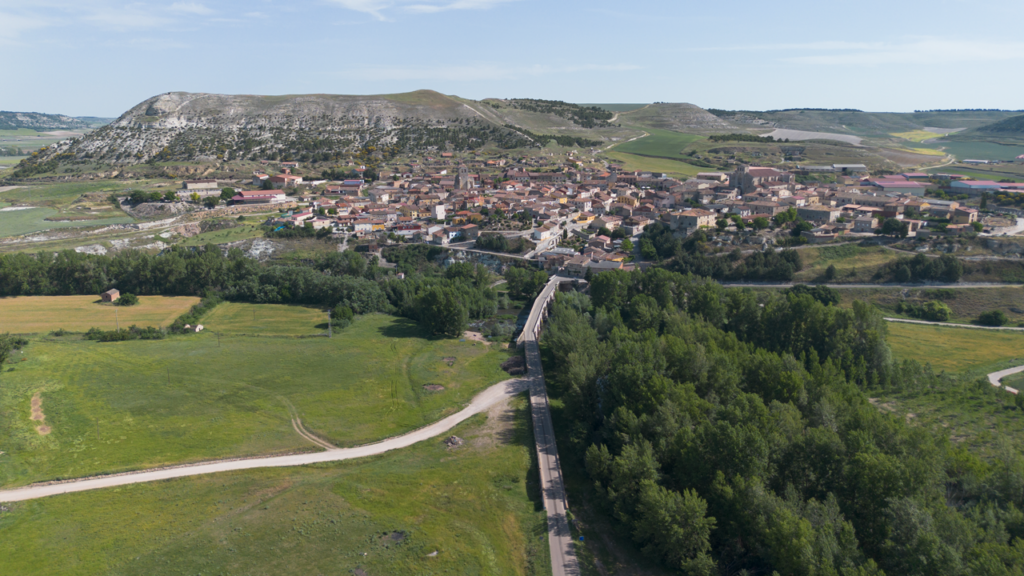
Given its position as a frontier town, Palenzuela was protected by a wall and a sturdy castle that dominated its eastern end, standing on a terrace overlooking the Arlanza valley. As the frontier moved further inland, the defences ceased to have any purpose and gradually fell into disuse, although the castle remained a symbol of feudal power, particularly under the Enríquez family, Admirals of Castile.
First documented in the 9th century, the castle and fortifications of Palenzuela were the scene of attacks, looting and key episodes in the town’s medieval history. They suffered Muslim raids in the 10th century, sieges by the royal troops of the regent queen María de Molina in the 13th century and by King Peter I in the 14th, further attacks with artillery in the 15th century during the reign of John II, and, in the 19th century, occupation by French garrisons during the Peninsular War.
Today, all that remains of the castle are the ruins of two towers and the base of a third, together with fragments of walls where door and window openings can still be seen. The whole structure, built of rammed earth and masonry with visible remains of the timber framework, offers a vivid picture of the fortress’s original solidity and the power that Palenzuela once wielded.